
S0Year 1Topics 1–4
Counting Recap
History
Tally marks and the first counting tools of ancient history.
Used in
Counting money, objects and time.
1 unit in this stage
N0.1Counting 1-100 recap
Counting to Calculus · Learning Institute for Excellence
One route from place value in Grade 3 to the mathematics that builds, trains and evaluates AI models. Every topic is taught once, at the moment it is needed, and then used in every course that follows.
No account neededProgress saves in your browser35 minutes a day
Counting to Calculus
Swipe the route →
172 units and 491 topics include the optional Beyond stage. The planner tracks the core journey: 167 units and 470 topics.
Why this route
Most sequences march forward whether or not the student is ready. Counting to Calculus is built the other way around: diagnose first, teach each idea once, and do not open the next door until the last one is secure.
Students move forward by the calendar, not by mastery, so gaps pile up until Algebra exposes them.
Diagnostic placement, a 90% mastery gate, and a dashboard that shows the next unit the student is ready for.
Spiral curricula re-teach the same topics every year, which wastes years of a strong student's time.
Each topic is taught once and then reused. The time saved goes to Calculus, Linear Algebra and AI.
Mathematics feels like disconnected rules, so students memorize procedures without seeing the story.
One story from counting to calculus. Each stage opens with its history — Euclid, al-Khwarizmi, Newton, Euler, Gauss — and its real uses.
School math stops at Calculus and never connects to how AI actually works.
The journey continues to Linear Algebra, Probability, Data Science (OpenStax) and a capstone in the Mathematics of Machine Learning, including model evaluation.
The route
From counting and place value to the mathematics of neural networks. Each stage names the units it contains, the history behind the ideas, and the places those ideas are used. Open any stage to see every unit.
Tally marks and the first counting tools of ancient history.
Counting money, objects and time.
N0.1 Counting 1-100 recapHindu-Arabic numerals: Brahmagupta's zero, al-Khwarizmi, Fibonacci's Liber Abaci.
Reading large numbers in budgets, populations and distances.
N1.1 Place value to 1,000N1.2 Place value to billions; roundingN1.3 Addition & subtraction recapN1.4 Multiplication facts recap & propertiesN1.5 Multi-digit multiplicationN1.6 Division & long divisionN1.7 Order of operationsN1.8 Factors, multiples & primesN1.9 Whole-number exponentsEgyptian unit fractions (Rhind papyrus); Simon Stevin's decimals.
Recipes, measurement, money and sharing.
F2.1 Meaning of fractionsF2.2 Comparing fractions; mixed numbersF2.3 Adding & subtracting fractionsF2.4 Multiplying & dividing fractionsF2.5 Decimal place valueF2.6 Decimal operationsF2.7 Fraction & decimal problem solvingEratosthenes measures the Earth; Archimedes and pi.
Building, maps and sports statistics.
M3.1 Measurement & conversionsM3.2 Perimeter & areaM3.3 Lines, angles & shapesM3.4 CirclesM3.5 Volume & surface areaM3.6 Coordinate planeM3.7 Data displaysPythagoras; Diophantus' Arithmetica; Brahmagupta's rules for negative numbers.
Discounts, interest, scale models and temperature.
P4.1 Ratios, rates & proportionsP4.2 PercentP4.3 IntegersP4.4 Rational numbersP4.5 Exponent rules & scientific notationP4.6 Roots & the real numbersP4.7 Variables & expressionsP4.8 One- & two-step equations and inequalitiesP4.9 Multi-step equationsP4.10 Pythagorean theoremP4.11 Transformations & similarityP4.12 Angle relationshipsP4.13 Cones, spheres & pyramidsP4.14 Introductory probabilityP4.15 Introductory statisticsal-Khwarizmi's al-Jabr; Descartes joins algebra and geometry.
Phone plans, break-even points, projectile paths and population growth.
A5.1 FunctionsA5.2 Linear functionsA5.3 Linear modelingA5.4 Systems of equationsA5.5 Inequalities & absolute valueA5.6 PolynomialsA5.7 FactoringA5.8 Quadratic equationsA5.9 Quadratic functionsA5.10 Exponential functionsA5.11 RadicalsA5.12 Rational expressionsA5.13 Arithmetic & geometric sequencesA5.14 Piecewise & step functionsEuclid's Elements: 2,000 years of proof.
Architecture, engineering drawings and GPS.
G6.1 Foundations & constructionsG6.2 Logic & proofG6.3 Parallel & perpendicular proofsG6.4 Triangle congruenceG6.5 Triangle relationshipsG6.6 SimilarityG6.7 Right trianglesG6.8 Quadrilaterals & polygonsG6.9 CirclesG6.10 Area & volume derivedG6.11 Coordinate geometryG6.12 Geometric probabilityCardano and the cubic; Napier's logarithms; Euler's e.
Earthquake scales, pH, compound growth and signal processing.
B7.1 Complex numbersB7.2 Polynomial functionsB7.3 Rational functionsB7.4 Inverse & radical functionsB7.5 Exponentials & logarithmsB7.6 Systems in three variablesB7.7 Function transformationsB7.8 SeriesB7.9 Counting & the binomial theoremB7.10 Nonlinear systemsHipparchus, Ptolemy, Aryabhata, Regiomontanus.
Surveying, navigation, sound and light waves.
T8.1 Right-triangle trigonometryT8.2 Radian measureT8.3 The unit circleT8.4 Graphs of trig functionsT8.5 Inverse trig functionsT8.6 Trig identitiesT8.7 Trig equationsT8.8 Oblique trianglesApollonius' conics; Fermat and Descartes.
Satellite orbits, robotics and computer graphics.
C9.1 Function analysisC9.2 Conic sectionsC9.3 Parametric equationsC9.4 Polar coordinates & polar complex numbersC9.5 Vectors in the planeC9.6 Induction & convergenceC9.7 Introduction to limitsNewton and Leibniz; Cauchy makes limits rigorous.
Velocity, optimization in business and engineering, rates of change.
K11.1 Limits & continuityK11.2 The derivativeK11.3 Transcendental derivativesK11.4 Related ratesK11.5 Applications of derivativesK11.6 The integralK11.7 SubstitutionK11.8 Applications of integrationThe Bernoullis, Brook Taylor and Euler's series.
Physics of work and fluids, approximation in computing.
K12.1 Physical applicationsK12.2 Techniques of integrationK12.3 Numerical & improper integralsK12.4 First differential equationsK12.5 Sequences & seriesK12.6 Power & Taylor seriesK12.7 Parametric & polar calculusLagrange, Gauss, Green and Stokes.
Fluid flow, electromagnetism, 3D graphics and machine-learning gradients.
K13.1 Vectors & geometry of spaceK13.2 Vector-valued functionsK13.3 Partial derivativesK13.4 Gradient & chain ruleK13.5 Multivariable optimizationK13.6 Multiple integralsK13.7 Vector fields & line integralsK13.8 Surface integralsGauss's elimination; Cayley and Sylvester's matrices.
Computer graphics, search engines and every neural network.
L14.1 Linear systemsL14.2 Matrix algebraL14.3 DeterminantsL14.4 Vector spacesL14.5 Linear transformationsL14.6 Eigenvalues & eigenvectorsL14.7 Orthogonality & least squaresL14.8 Symmetric matrices & SVDBoole's logic; Euler's bridges of Königsberg; Turing.
Computer science, cryptography, networks and algorithms.
D15.1 LogicD15.2 Proof techniquesD15.3 Sets, functions & relationsD15.4 Advanced countingD15.5 Number theory & cryptographyD15.6 Graph theoryD15.7 Algorithms & complexityD15.8 Boolean algebra & automataEuler, Laplace and Fourier.
Circuits, vibrations, epidemics, heat flow and control systems.
E16.1 First-order equationsE16.2 Second-order linear equationsE16.3 OscillationsE16.4 Laplace transformsE16.5 Systems & stabilityE16.6 Series solutionsE16.7 Numerical methodsE16.8 Fourier series & PDEsPascal and Fermat; Bayes; Gauss; Fisher.
Medicine, polling, quality control and the foundation of machine learning.
R17.1 Study designR17.2 Exploring dataR17.3 ProbabilityR17.4 Discrete random variablesR17.5 Continuous & joint distributionsR17.6 Limit theoremsR17.7 EstimationR17.8 Hypothesis testingR17.9 RegressionR17.10 Bayesian inferenceFlorence Nightingale's charts; John Tukey's exploratory data analysis.
Public health dashboards, business forecasting and sports analytics.
DS1 Ch.1 What are data & data science; PythonDS2 Ch.2 Collecting & preparing dataDS3 Ch.3 Descriptive statistics (Python only)DS4 Ch.4 Inference & regression (Python only)DS5 Ch.5 Time series & forecastingDS6 Ch.6 Machine learning basicsDS7 Ch.7 Deep learning & AI basics (tools)DS8 Ch.8 Ethics in the data science cycleDS9 Ch.9 Visualizing dataDS10 Ch.10 Reporting resultsRosenblatt's perceptron; backpropagation; attention and transformers.
Building, training and evaluating real AI models.
X19.1 OptimizationX19.2 Regression models from scratchX19.3 Information theoryX19.4 Classical ML mathematicsX19.5 Neural networks & backpropagationX19.6 CNNs, RNNs & transformersX19.7 Probabilistic & generative modelsX19.8 Training language modelsX19.9 Evaluation & evalsX19.10 Capstone projectCauchy, Weierstrass, Galois, Riemann.
Research mathematics, ML theory and scientific computing.
Z20.1 Real AnalysisZ20.2 Abstract AlgebraZ20.3 Numerical AnalysisZ20.4 Convex OptimizationZ20.5 Complex AnalysisHow it works
These are not slogans. They decide what gets taught, when a student moves on, and what happens when something is missing.
If a topic is covered in one course, it is not taught again. It returns as a prerequisite and in mixed review. Right-triangle trig lives only in Trigonometry; separable equations in Calculus 2; neural networks in the capstone.
A struggling student always knows exactly where to go back. Click any “needs” tag in the planner to jump there.
Tick what the student already knows. The dashboard starts them at the first unit whose prerequisites are all mastered.
A unit counts as mastered at 90% or better on a cumulative check. The review buffer pays for the mixed reviews.
The same words for the same idea from Pre-Algebra to Calculus. Each stage opens with its history and the places it is used.
Statistics comes after Calculus 3 and Linear Algebra, so distributions, maximum likelihood and regression are taught once, properly.
A week at 35 minutes
Five days a week, weekends off. Each week has a rhythm: a new idea, practice, a second idea, an application, then review and a mastery tick.
Open with the history, then the concept, then practice.
ConceptWorked examples, then problems that grow harder.
FluencyThe next topic in the unit, linked to Monday's.
ConceptA science or technology problem. From Algebra 1 on, partly in Python.
ApplicationMixed review, a teach-back, then tick mastered topics here.
MasteryWeekends off. Up to 4 weeks off a year. A 10% review buffer pays for mixed review and mastery checks. Readiness matters more than the calendar: the gate decides when a student moves on.
The Journey Planner
The companion planner turns the full scope and sequence into a working dashboard: who is studying, what they have mastered, what comes next, and how long the road will take at your pace.
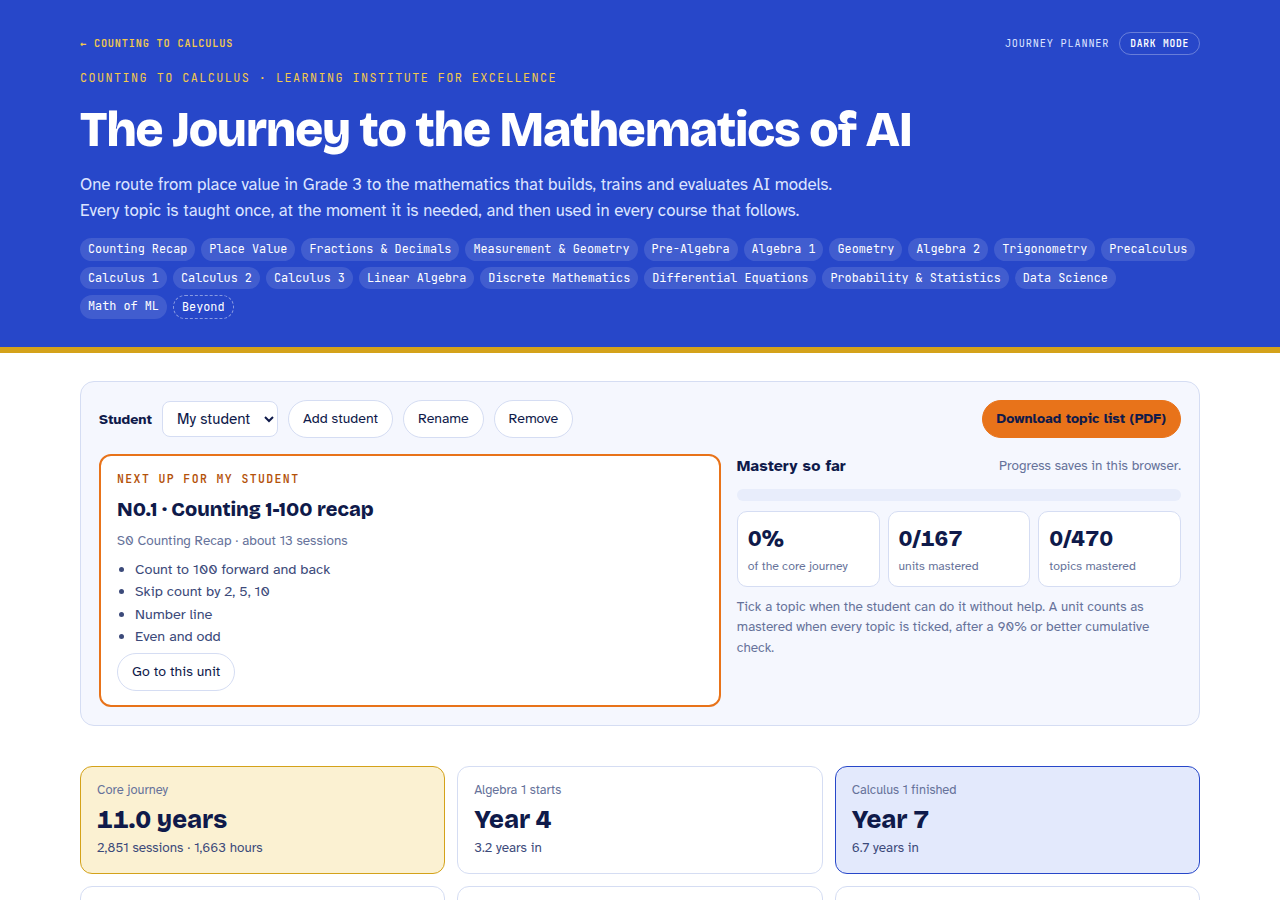 Live planner
The people behind the ideas
Every stage opens with its history and its uses, because an idea is easier to trust when you know who found it and what it was for. These are the chapters students meet along the way — not trivia, but the reason each tool exists.
Tally marks · counting tools of the ancient world
Long before numerals, people kept count with marks and tokens. The idea was simple and revolutionary: a number can be recorded outside the mind. Every later stage depends on it.
Brahmagupta · al-Khwarizmi · Fibonacci
Brahmagupta gave zero a place among the numbers; al-Khwarizmi wrote al-Jabr, the book that gave us the word algebra; Fibonacci carried the Hindu-Arabic system into Europe in Liber Abaci. Place value is why long multiplication works.
Euclid · Archimedes · Eratosthenes
Euclid's Elements made proof a way of knowing, not just a way of calculating. Archimedes bounded pi; Eratosthenes measured the Earth with shadows and geometry. Geometry is where students first learn to prove.
Newton · Leibniz · the Bernoullis · Euler
Newton and Leibniz found the calculus of change; Euler gave it e, series and the language of growth. Maxwell would later write the laws of electromagnetism in the vector calculus of Stage 12 — the bridge from pure mathematics to the physical world.
Gauss · Cayley · Sylvester · Bayes · Fisher
Gauss gave us elimination and least squares; Cayley and Sylvester made the matrix an object of study; Bayes and Fisher taught us to update belief with evidence and to estimate what we cannot see. This is the mathematics behind every model that learns.
Euler · Boole · Turing
Euler's bridges of Königsberg began graph theory; Boole turned logic into calculation; Turing asked what a machine can compute. Discrete mathematics is the grammar of computer science.
Nightingale · Tukey · Rosenblatt · backpropagation · transformers
Nightingale's charts persuaded a nation to reform its hospitals; Tukey made exploratory data analysis a discipline; Rosenblatt's perceptron, backpropagation and the transformer turned statistics and linear algebra into learning machines. This is where the road arrives at AI.
These are not decorations on a syllabus. Students meet each name when the idea arrives — and then use it. Counting to Calculus is part of an international collaborative strategy to put mathematics, science, AI and STEM to work on practical problems around the world, from the classroom to the lab to the field.
History notes follow the CTC Complete Topic List (November 2026). For dates, works and biographies, see the MacTutor History of Mathematics Archive and the Stanford Encyclopedia of Philosophy. The data-science stage uses OpenStax Principles of Data Science (free, CC BY-NC-SA 4.0).
Works in any school system
The stages map to conventional milestones without being captive to them. Use the table to translate the journey into the language your school, co-op or university already uses.
| Stages | United States | England / Cambridge | IB | Elsewhere |
|---|---|---|---|---|
| S0–S4 Foundations | Common Core Grades 3–8 | KS2–KS3; Cambridge Lower Secondary | MYP 1–3 | Singapore Primary 3 – Sec 2 |
| S5–S9 High School Core | CCSS High School; AP Precalculus | GCSE Higher; A-Level Pure | MYP 4–5; DP AA SL | India CBSE 9–12 |
| S10–S16 University Core | AP Calculus AB/BC, AP Statistics and beyond | A-Level Further Maths; first-year university | DP AA HL and beyond | First-year university anywhere |
| S17–S18 AI Capstone | OpenStax Principles of Data Science (free, CC BY-NC-SA 4.0) and university-level mathematics of machine learning | |||
Session counts are 35-minute lessons with practice, from the Counting to Calculus master curriculum. They are estimates for mastery-based, one-to-one or small-group study. Readiness matters more than the calendar: the mastery gate decides when a student moves on.
Who it is for
The sequence is the same. What changes is who runs the day-to-day lesson and how much support a family wants.
You do not need to teach like a professor. Add a student, run the diagnostic, and follow the unit marked Next up. The planner keeps the routine; the curriculum keeps the sequence.
Open the plannerOne sequence for a mixed-age room. Every unit names its prerequisites, so a new student can be placed with a short diagnostic instead of a guess — and the Friday review keeps earlier work alive.
See the school mapBring the full route to a school, or let CTC tutors teach the stages a parent cannot: Calculus 3, Linear Algebra, Differential Equations and the machine-learning capstone. Parents run the routine and the dashboard.
Join the programQuestions
A few honest answers about where the route starts, how fast it moves, and what a parent is actually responsible for.
Talk to the CTC teamStart here
Open the planner, add a student, and tick what they already know. The dashboard will show the first unit whose prerequisites are all mastered — the honest starting line.
Ready for the full program? Sign up at countingtocalculus